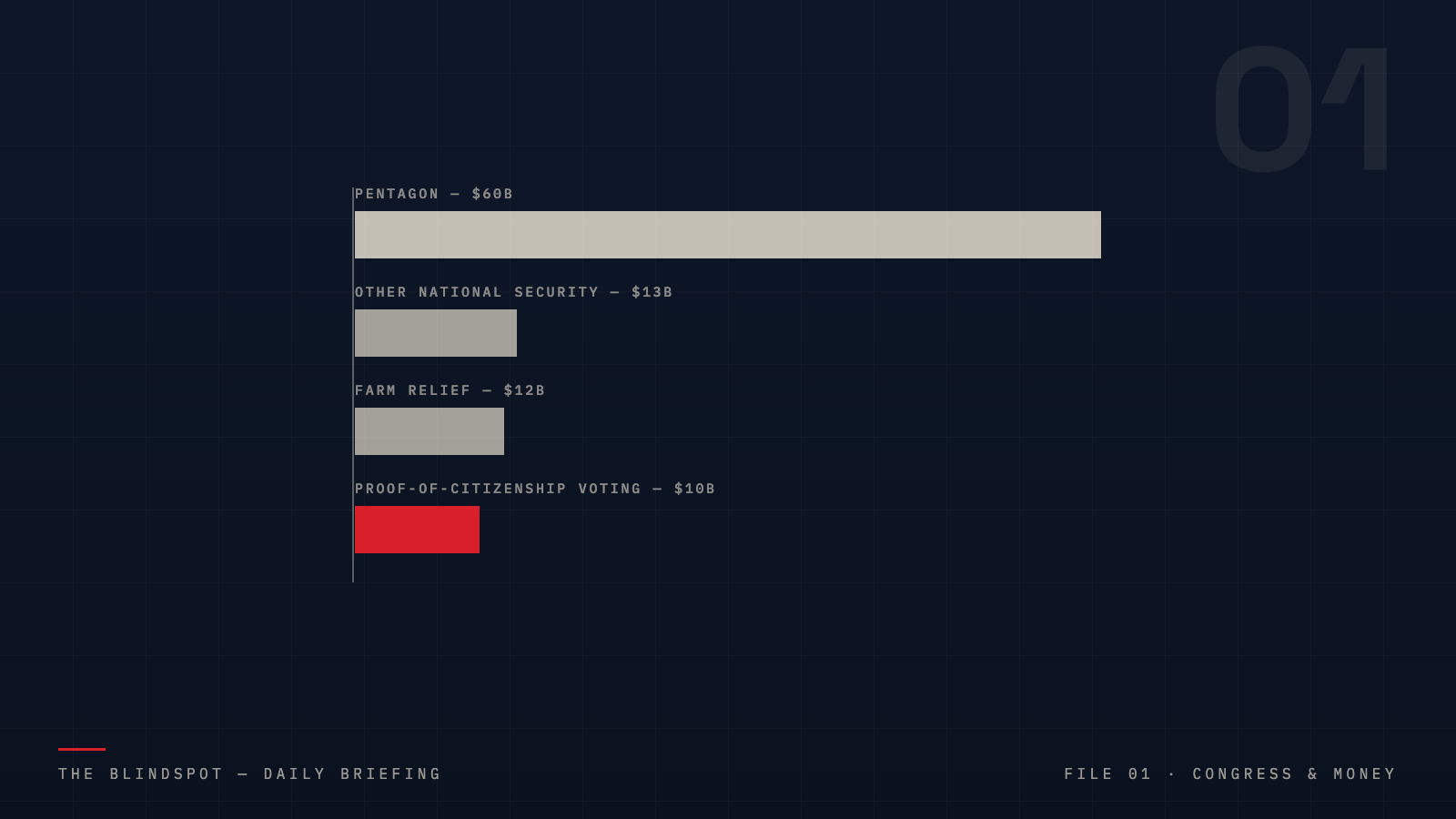
The record first. On July 22 the House approved a $95 billion budget framework by a vote of 216 to 214, using the reconciliation process — the procedure that lets budget legislation pass the Senate with a simple majority, beyond the reach of a filibuster. The package directs roughly $60 billion to the Pentagon, $13 billion to other national-security accounts, $12 billion to farmers absorbing losses from the administration’s tariff regime, and $10 billion toward proof-of-citizenship voting measures drawn from the SAVE America Act.
Every Democrat voted no. Two Republicans — Thomas Massie of Kentucky and Warren Davidson of Ohio — joined them, as did Kevin Kiley of California, a Republican turned independent who argued that war funding should never move on a party-line vote. Senate Majority Leader John Thune has declined to commit to the framework, suggesting the chamber may instead hold it in reserve as a fallback ahead of the September government-funding deadline.
The invoice, not the war
Reconciliation was invented as bookkeeping. The Congressional Budget Act of 1974 created it as a technical device for aligning existing law with the annual budget resolution; it was first used in 1980, and the Byrd Rule was bolted on in 1985 precisely because senators worried the shortcut would attract legislation that had nothing to do with budgets. The worry was sound. Welfare reform in 1996, the tax cuts of 2001 and 2003, the final piece of the Affordable Care Act in 2010, the 2017 tax law, the pandemic relief act of 2021, the Inflation Reduction Act of 2022 — for three decades, much of the largest domestic legislation in American life has traveled through the exception rather than the rule. This is the third reconciliation package of the current Congress. What was designed as a maintenance procedure now functions as an alternative legislature, one in which the minority party is a spectator.
The novelty this week is what the vehicle is carrying. War funding has traditionally moved through supplemental appropriations, negotiated across the aisle on the theory that soldiers in the field should not depend on one party’s margin — the tradition Kiley invoked in his dissent. Eighteen American service members have died in the Middle East operations this framework would fund. Their mission is debated nowhere in the text; the text concerns only the invoice. And stapled to that invoice is a change to how Americans register to vote, priced at $10 billion, that could not survive a Senate debate on its own terms.
What survives the Senate
The framework now meets two tests. The first is arithmetic: the Republican Senate majority is narrow, and its members are divided over both the military spending levels and how to pay for them. The second is procedural: the Byrd Rule lets senators strike provisions whose budgetary effects are “merely incidental” to their policy aims — a description the voting measures will struggle to escape. The parliamentarian’s ruling on that question, an unelected official applying a 1985 rule to a 2026 war, may matter more than the floor vote. The September funding deadline is the clock running behind all of it.